
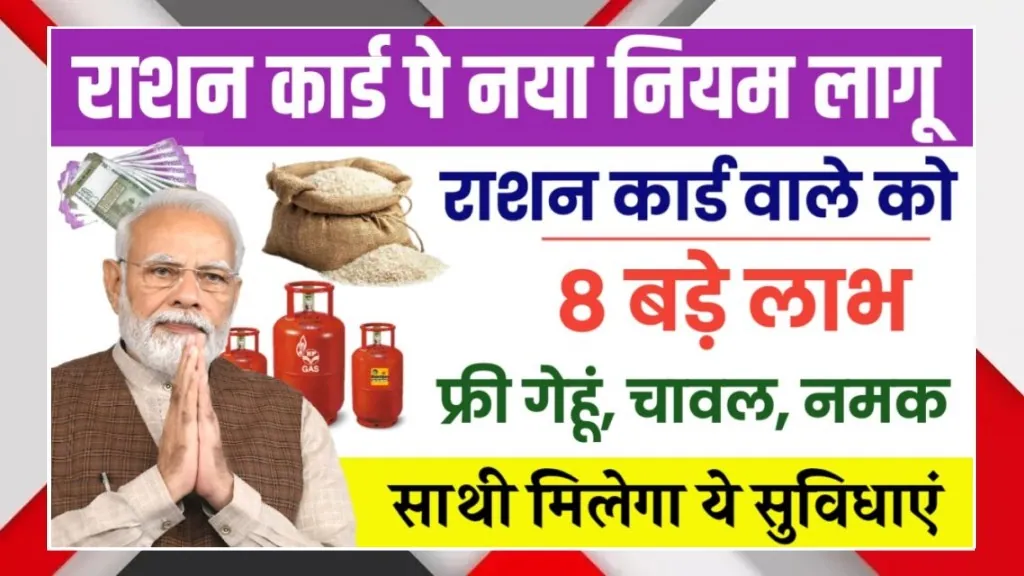
The government has introduced new ration card rules to strengthen food security and support low-income families across India. Under these updated guidelines, eligible ration card holders can now access multiple benefits beyond basic food grains. The focus is on providing free wheat, rice, and salt, along with additional facilities that improve daily living standards. These changes aim to reduce household expenses, ensure transparent distribution, and eliminate fake beneficiaries through digital verification. With technology-driven systems and welfare-linked benefits, the ration card is no longer limited to food support but has become a key document for accessing several essential government facilities.
Eight Major Benefits Under New Ration Card Rules
The updated ration card policy offers eight important benefits designed to provide financial relief and food security. The most significant benefit is free distribution of wheat and rice under the National Food Security Act. In some states, salt is also provided either free or at a highly subsidized rate. These benefits help families manage rising inflation and reduce monthly grocery expenses. The government’s aim is to ensure that no eligible family sleeps hungry while maintaining fairness and accountability in the system.
Free Wheat, Rice, And Essential Food Items
Ration card holders are entitled to receive free wheat and rice every month as per their eligibility category. Antyodaya families receive a higher quantity compared to priority households. Along with grains, several states now include salt, sugar, or pulses under state-specific schemes. This ensures nutritional balance and basic food availability. The quality and quantity of food grains are monitored digitally to reduce leakage and corruption in the public distribution system.
Mandatory e-KYC And Aadhaar Linking
One of the biggest changes is the mandatory e-KYC and Aadhaar linkage with ration cards. This step ensures that only genuine beneficiaries receive free ration benefits. Without completing e-KYC, ration distribution can be temporarily stopped. This rule helps eliminate duplicate and fake ration cards while improving transparency. Beneficiaries can complete e-KYC through fair price shops or online portals, making the process simple and accessible.
One Nation One Ration Card Facility
The new rules strengthen the One Nation One Ration Card scheme, allowing beneficiaries to collect ration from any fair price shop across India. This is especially helpful for migrant workers and families who move frequently for work. With biometric verification, ration can be accessed anywhere without changing the ration card. This portability ensures continuous food support regardless of location.
Digital And Transparent Distribution System
Ration distribution is now more transparent with digital records, biometric authentication, and real-time data tracking. Fair price shops use electronic point-of-sale machines to record transactions instantly. This reduces corruption, ensures accurate distribution, and builds trust among beneficiaries. Complaints can also be registered online, making grievance redressal faster and more effective.
Additional Welfare Scheme Linkage
Ration cards are increasingly being linked with other welfare schemes such as health insurance, housing schemes, and pension benefits. This makes the ration card an important identity document for accessing government support. Eligible families may receive priority benefits in schemes related to education, healthcare, and financial assistance.
Option Of Advance Or Combined Ration Distribution
In some states, ration card holders can receive two or three months’ ration at once, especially during festivals or emergencies. This reduces the need for frequent visits to ration shops and provides better planning for households. The system is designed to offer flexibility while ensuring food security throughout the year.
Improved Grievance Redressal And Monitoring
The new ration card rules also focus on improving grievance redressal mechanisms. Beneficiaries can report issues related to quantity, quality, or denial of ration through helplines or online portals. Regular monitoring and audits ensure fair implementation. These reforms make the ration card system more efficient, reliable, and beneficial for millions of families.